Every year somebody tells me that physics needs a proper laboratory. Then I hand them a piece of string and a potato, and we measure the acceleration of gravity. Attention to detail is the real constraint, and that fits on a kitchen table.
Here’s the whole equipment list: a kitchen scale that reads to 1 g, a measuring jug with milliliter marks, about 2 m of string, a ruler, a phone with a stopwatch and a slow-motion camera, a microwave oven, and a chocolate bar. If you own a kitchen, you own the equipment. What you’re short of is the habit of writing down every measurement with its unit, which is the actual subject of this post.
Gravity from string and a shoe
Tie a shoe to about 100 cm of string, hold the other end, and let it swing. Not too far: the formula assumes a small angle, so keep the shoe below 10 cm of sideways travel. Time 20 full swings, then divide by 20. My last attempt: 20 swings took 40.2 s, so the period is T = 40.2/20 = 2.01 s.
The pendulum formula rearranges to g = 4π²L/T². With L = 1.00 m and T = 2.01 s, that’s g = 4 × 9.87 × 1.00 / 4.04 = 9.77 m/s². The accepted value is 9.81 m/s², so I’m off by 0.4%, which is honest for a shoe. Measure the string from the pivot to the shoe’s center of mass, count the swing at its lowest point, and repeat three times. Two of my three runs land within 0.5% of 9.81. The third one didn’t, because a doorbell rang mid-count.
Why twenty swings and not one? Timing a single swing on a phone, your reaction error is maybe 0.2 s out of 2 s, which is 10% straight away. Timing 20 swings keeps that same 0.2 s of error but spreads it over 40 s, so the error drops to 0.5%. Cheapest precision upgrade in experimental physics: measure many, divide at the end.
The potato density department
Weigh the potato: mine reads 212 g. Fill the jug to 500 mL, drop the potato in, read the new level: 670 mL. The potato pushed 170 mL of water out of the way, so its volume is 170 cm³, and its density is 212 g / 170 cm³ = 1.25 g/cm³. Water is 1.00 g/cm³, so the potato sinks, slowly and without drama.
The usual error here is water clinging to the potato when you fish it out, and the second is parallax on the jug’s meniscus. Both are worth having. Physics at home teaches you that a number without an error estimate is a guess with delusions.
Then salt the water. Dissolve 150 g of table salt in a liter and the density climbs to roughly 1.10 g/cm³; the potato still sinks. Add another 100 g and you pass the potato’s 1.25, and it floats with only a cap showing. The calculation predicts the float point before the potato confirms it, which is the whole experience of physics in one kitchen gesture.
Light in the microwave
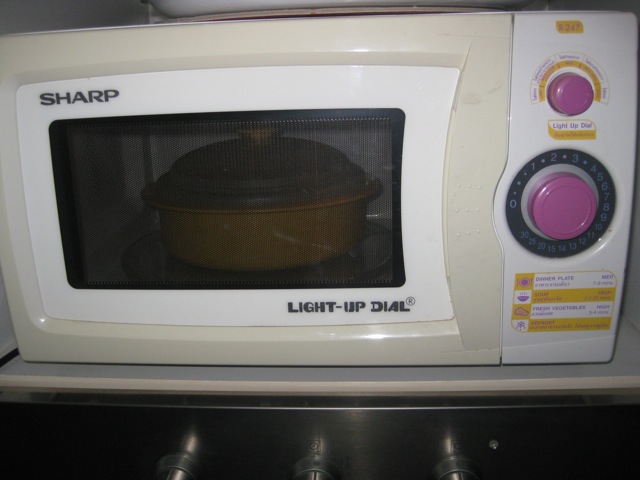

Take the turntable out of the microwave (or prop the chocolate flat on an inverted bowl), lay the bar on a plate, and run the oven for 20 to 30 seconds. Soft spots appear in rows. Measure three separate spacings between neighboring spots and average them: I got 6.0, 6.2, and 5.9 cm, so 6.03 cm. The spots are standing waves: microwaves bounce off the metal walls, and where the reflected waves add up, the chocolate melts first, half a wavelength apart.
Microwaves are light, and the hot spots sit half a wavelength apart, so the wavelength is λ = 2 × 6.03 cm = 12.1 cm = 0.121 m. The frequency is printed on the back of the oven: 2.45 GHz = 2.45 × 10⁹ Hz. Multiply: c = fλ = 2.45 × 10⁹ × 0.121 = 2.96 × 10⁸ m/s. The accepted speed of light is 2.998 × 10⁸ m/s, so a chocolate bar and a ruler get you within 2%. Don’t run the oven empty, and don’t touch the chocolate for a minute afterward.
The chocolate covers light. Sound takes two phones and a stairwell. Put one phone 10 m away, record on both, clap once, and compare the waveforms: my clap arrived 29 ms late. Speed is distance over time: 10 m / 0.029 s = 344 m/s. Sound in air runs about 331 + 0.6T m/s, where T is in Celsius, so 344 m/s matches a room at roughly 21 °C. That’s my room, checked with the same thermometer I use for the kettle.
Your precision comes from the waveform display. A clap judged by ear carries an uncertainty of 0.1 s at best, which would ruin the measurement; a recorded waveform lets you read the delay to about 1 ms. That’s a factor of a hundred, gained by changing the tool instead of trying harder.
Write each measurement down as you take it, with its unit, and keep the raw values: the 40.2 s, the 212 g, the 670 mL. Computed answers are cheap; the raw measurements are what another person needs to judge your work. Repeat each measurement at least twice and average. Report the spread, even if it’s just “two runs within 0.5%”.
State your expected accuracy before you measure. For g from a shoe, 9.8 ± 0.2 m/s² is a realistic claim. For the speed of light from chocolate, 3.0 × 10⁸ ± 0.2 × 10⁸ m/s. Setting the range first removes the human temptation to round toward the textbook. Then hand the raw data to someone else and let them compute the answer. If they get 9.8 m/s² from your 40.2 s, your record-keeping worked.
For the general map of what all these measurements belong to, the reference I keep sending students to is the overview of physics on Wikipedia. Read it for ten minutes, then put the phone on stopwatch duty and start swinging the shoe. The point of these experiments is that they force you to confront your own measurements rather than the answer key. The potato doesn’t grade on a curve.