Categories
General

A Field Guide to Bad Physics on the Internet

The internet produces physics-shaped content faster than any teacher can grade it. After fifteen years of students sending me links, I’ve sorted the material into a handful of recurring shapes. Learn the shapes and you can triage a video in under a minute. The shapes repeat because the incentives repeat: a good physics video takes a week of calculation, and a bad one takes an afternoon of enthusiasm.

The recurring character is the garage inventor with a machine that produces more energy than it consumes. The camera loves these. The wiring in the base is always a tangle, which is convenient, because a tangle hides a battery. A variant runs on magnets arranged just so, which is how you know nobody in the video has read a force diagram.

The usual suspects

Coastal East Lothian , The Usual Suspects at Victoria Harbour, Dunbar - geograph.org.uk - 2083532
Photo by Richard West on Wikimedia Commons

Perpetual motion machines fail the same way every time: energy leaves the system somewhere the camera doesn’t point. A machine powering a 1000 W heater “forever” delivers 24 kWh a day, which is 8.6 × 10⁷ J, and the inventor never says where it enters. Magnets don’t supply it, since a magnet returning to its starting position has done no net work.

Second shape: the word “quantum” doing the job of an equation. Quantum mechanics is a specific mathematical theory with a track record of correct predictions. If a claim about healing water or a frequency bracelet cites “quantum resonance” and no numbers, it’s borrowing the word’s prestige and skipping the word’s content.

Third shape: relativity as a slogan. “Everything is relative” is usually a request to stop checking. In physics, relativity means specific statements about measurements in different reference states, most famously that the speed of light is the same for all of them. It constrains claims tightly.

Fourth shape: the single unrepeatable demonstration. A guy in a workshop does an experiment once, on camera, with a result that would overturn a well-tested law. Real experiments come with error bars, repeated trials, and an apparatus description. If the video has a dramatic soundtrack instead of those, grade accordingly.

Resonance gets abused often enough to count as its own subgenre. The Tacoma Narrows bridge failure appears in hundreds of videos as proof that any vibration destroys anything. The bridge twisted in a wind-driven aerodynamic flutter, which is related to resonance the way a car crash is related to parking. The video’s lesson is real physics with the mechanism swapped out.

Another shape lives in headlines rather than videos: the experiment that “changes everything”, reported before the paper exists. Ask for the paper. If one turns up, read the units in the abstract before you read the claims in the press release. If none exists, the story has already done all the physics it plans to do.

Four questions that do the grading

Yellow letter tiles spell 'questions' on a contrasting blue background.
Photo by Ann Hannes on Pexels

Where does the energy enter, and where does it go? Most fake machines fail this question alone. What are the units? A claim expressed only in adjectives has told you nothing measurable. Can I compute the number myself with high-school physics? For the magnet motor, I did, and 8.6 × 10⁷ J a day appeared out of nowhere. What does the claimant lose if they’re wrong? People who are right accept tests and bets. People who are selling something decline both, politely, and upload another video.

I grade these videos the way I grade homework: units first, enthusiasm second. Two minutes with a calculator disqualifies most of the genre, which leaves you the good stuff, where the physics is real and the numbers hold up.

Categories
General

Where School Physics Stops Being Enough

Every year one or two students finish the school course early and tell me physics has become easy. I set them a different problem and watch the confidence drain away in about six minutes. That moment is worth describing, because what happens next decides whether they keep going or quietly decide the subject got boring.

Here’s the school version. A 2 kg block slides down a 30° incline with friction coefficient 0.2. Find the acceleration. Along the slope: a = g(sin θ − μ cos θ) = 9.8(0.500 − 0.2 × 0.866) = 9.8 × 0.327 = 3.2 m/s². One free-body diagram, one equation, done. This is the problem the textbook gives you after teaching you the method.

Now the harder version. The incline is a wedge of mass 3 kg sitting on smooth ice, free to slide. Find the acceleration of both the block and the wedge. The block pushes the wedge sideways, the wedge runs away underneath it, the normal force isn’t mg cos θ anymore, and you have two bodies with one constraint: the block stays on the surface. You need conservation of momentum in the horizontal direction, a kinematic constraint, and a free-body diagram for each object, all at once. The solution is maybe twelve lines of algebra where the school version was two. Physics gets wider here, and the width is what trips people.

Here’s the shape of the solution, which I’ll leave you to fill in. Write conservation of momentum in the horizontal direction, because the ice is smooth and nothing pushes the system sideways. Write the constraint that the block never leaves the wedge face. Draw both free-body diagrams and solve the system together. Three ideas, one set of equations. That combination is the jump, and it’s the same jump in every harder problem you’ll meet.

What actually changes

Motivational text 'Actually I Can' on a grid paper background. Black and white close-up.
Photo by Bich Tran on Pexels

School problems are built to use exactly the law you just learned. Olympiad problems pick the law for you. A national olympiad problem might ask about a chain sliding off a table (variable mass, use energy) or a charged ball on a rotating hoop (constraints plus circular motion), and the hard step is always the same: choosing the tool. Problem books are how you build that instinct. There are classic collections, the kind with 2000 problems sorted by topic, where a student is expected to spend 40 minutes on a single question before looking at anything. University courses raise the floor again: mechanics rebuilt on energy and later on Lagrangians, electromagnetism rebuilt on vector calculus. The equations from school survive as special cases.

The students who handle this well share a habit. They keep a notebook of their failed attempts, they reread problems they couldn’t do, and they treat a solution manual as a source of methods rather than answers. The ones who struggle treat difficulty as evidence of talent running out.

When I hand out a diagnostic set of ten olympiad problems, I watch a different number than the score. I measure how long the student works on the unsolved ones before giving up. Twenty minutes of honest attempts beats a fast surrender every time, and it’s the single best predictor I have of who survives the jump.

How I’d choose a paid course

A woman holds a mug with 'choose happy' text indoors, promoting positivity.
Photo by Kristina Paukshtite on Pexels

At some point you’ll consider paying for help: an olympiad training program, a university-prep course, a tutor. Some are worth the money and some are expensive video folders. Since I can’t recommend specific products without knowing your situation, here’s the checklist I give parents, in order of weight.

First, find the problem sets before you pay. A serious course publishes its syllabus, and the syllabus lists problems. Topics are headings; problems are the product. “Ten hours of mechanics lectures” is a schedule; “40 graded problems with written feedback” is a course. Count the graded problems, because that’s what you’re buying. Second, ask who reads your solutions. A human commenting on your work is worth several times the same content without feedback. Third, look for sample lessons, and judge them the way you’d judge a teacher: does the person do calculations on screen, or narrate over slides? A sample lesson should show someone writing an equation, checking units, making a mistake, and catching it. Slide narrations sell comfort. Calculations sell physics. Fourth, check the refund policy and the class size. Fifth, ignore the certificates.

Pacing belongs in the price too. Self-paced courses finish fewer students than scheduled ones, because deadlines are part of the product. If a program has weekly problem sessions with dates attached, that structure is worth real money, and I’d pay for it before I’d pay for extra video hours.

Here’s the arithmetic I use on price. A course at $300 with 40 graded problem sets costs $7.50 per set with feedback. A $50 video series with no graded work costs $50 per set of nothing. The second one isn’t a bargain; it’s a different, lighter product, and it should be priced like one. When a program costs real money, ask directly: how many problems will someone grade for me? The answer tells you the value.

Tutoring follows the same logic in reverse. A tutor at $60 an hour who assigns you work between sessions and grades it is cheaper than a $30 an hour tutor who re-explains your homework to you. The work between the hours is where the learning happens.

Books and the long route

Expansive view of the historic Long Room library in Trinity College Dublin.
Photo by Ann Marie Kennon on Pexels

Before paying anyone, buy a used textbook. The standard first-year university texts cost $150 new and $25 used, and the older edition teaches the same physics. Add a problem book, a notebook dedicated to failed attempts, and a timer. Work a problem for 40 minutes before reading a solution; when you do read one, cover it line by line and ask where each step came from.

There’s a free route as well. University syllabi are public, libraries hold the textbooks, and problem sets circulate online. What you lose without a course is feedback and deadlines, so if you self-study, build both: a calendar with dates, and a partner who exchanges solutions with you and argues about the steps.

Olympiad camps and summer schools exist in most countries, and plenty of them have scholarships, so the price on the website is rarely the final price. Study groups help more than expected: explaining your solution out loud is where half the understanding gets built.

What I tell students running out of school physics: pick one course or one problem book, finish it, and keep the notebook. The problems make you good at physics. Now go back to the wedge and try the twelve lines yourself.

Categories
General

Heat, Currents, and the Kettle Problem

My kettle is rated 2000 W and holds 1.5 L. That’s all the data you need for the problem I use to open the electricity unit: how long does a full kettle take to boil, what does it cost, and where does the energy actually go? The arithmetic is short. The physics underneath it took James Joule years.

Start with the water. One liter of water weighs 1 kg, so 1.5 L is m = 1.5 kg. My tap runs at 20 °C and the kettle stops at 100 °C, so ΔT = 80 °C. Water needs 4186 J to heat one kilogram by one degree, a number worth memorizing because it comes up constantly. Total energy: Q = mcΔT = 1.5 × 4186 × 80 = 502,320 J, call it 5.0 × 10⁵ J.

The arithmetic

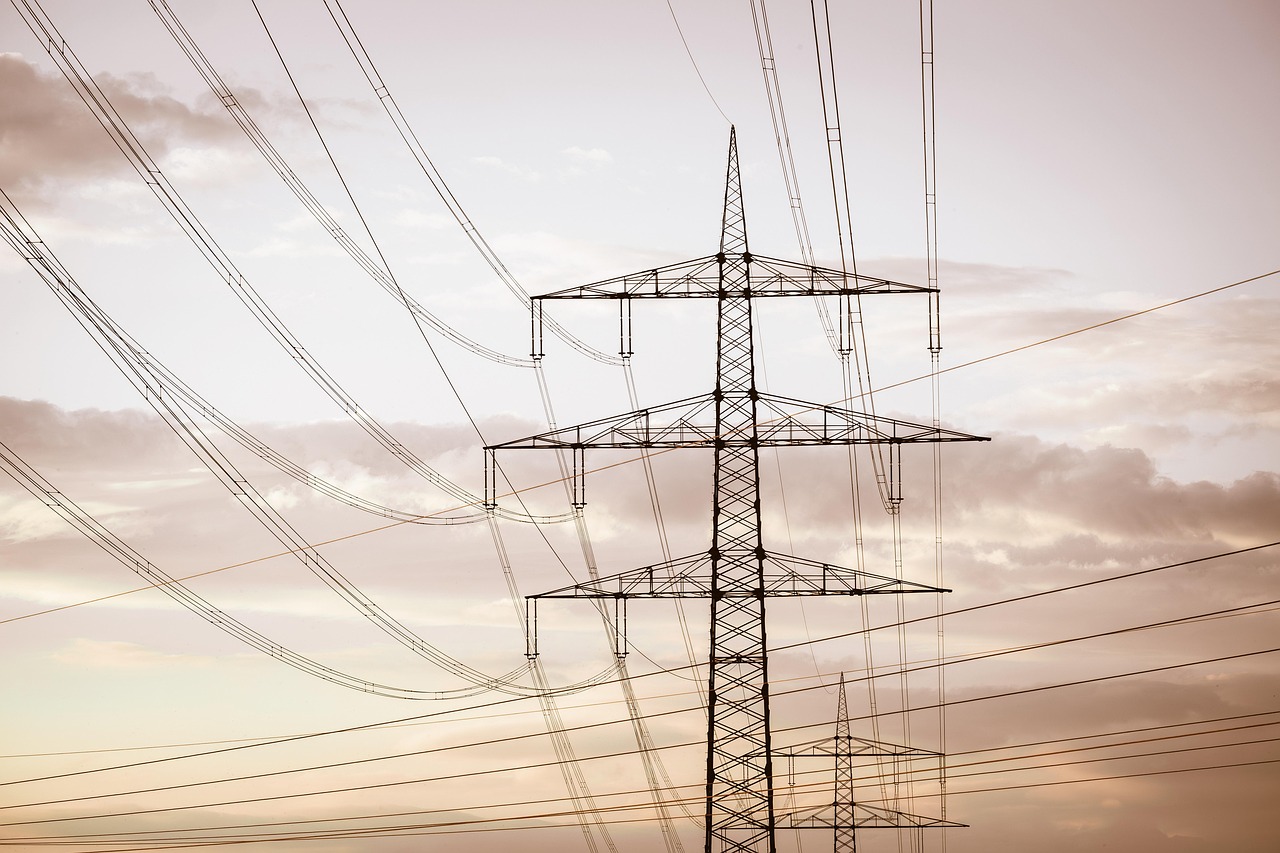
wires, electrical current, electricity, high voltage, energy, high voltage line, high voltage pylon, overhead lines, voltage, stole, power generation, power line, power pole, power supply, technology, environment, caution, electricity, electricity, electricity, electricity, electricity
Photo by Couleur on Pixabay

Power is energy per second, so time is energy divided by power: t = 502,320 J / 2000 W = 251 s. That’s 4 minutes 11 seconds. I ran the experiment before writing this: 4 min 30 s. The difference means about 90% of the electrical energy landed in the water, and the rest heated the kettle body, the counter, and my patience. That 90% is typical for a kettle, which is one reason I boil water electrically instead of on a gas ring.

A caution that trips up half the class: once the water hits 100 °C, the temperature stops climbing. The next 2.26 × 10⁶ J per kilogram goes into turning water into steam while the thermometer sits still. That flat line is water’s built-in thermostat.

Where the heat comes from

Northbourne, the October heat-wave comes to an end - geograph.org.uk - 2630566
Photo by Chris Downer on Wikimedia Commons

The heating element works by Joule heating: push current through a resistance and the electrical energy turns into thermal energy. The relations are P = IV and P = I²R. At 230 V, my kettle draws I = 2000/230 = 8.7 A, and its element has resistance R = V/I = 230/8.7 = 26 Ω. Every electron that squeezes through those 26 ohms pays a toll, and the toll is heat.

Joule established the exchange rate in 1843 with a falling weight turning paddle wheels in water: mechanical work becomes heat at 4.186 J per calorie. The old site had his experiment on the front page for years. Same physics, better kettle.

The same I²R explains two household facts worth knowing. Handles are plastic because they conduct heat poorly and cost little; the element is metal because it must resist current and survive 300 °C. And a worn socket with 0.5 Ω of contact resistance at 8.7 A dissipates I²R = 38 W, which is a small nightlight hidden in your wall. That’s why I check plugs before I check anything else.

The bill

Visit of Bill Gates, Chairman of Breakthrough Energy Ventures, to the European Commission 5
Photo by Lukasz Kobus/European Commission on Wikimedia Commons

Energy is power times time, so a boil is 2000 W × 251 s = 5.0 × 10⁵ J. Divide by 3.6 × 10⁶ J per kilowatt-hour and you get 0.14 kWh. At 30 cents per kWh, a full kettle costs about 4 cents. Four boils a day, every day, is under 50 cents a week. Tea remains one of the cheaper thermodynamic pleasures available.

Your numbers will differ: a 2200 W kettle, colder tap water, a lid left open. Redo the multiplication with your own measurements and see what your boil costs. If the clock disagrees with your calculation by more than 10%, something in your house is losing heat faster than mine.

Categories
General

The Experiments You Can Run on a Kitchen Table

Every year somebody tells me that physics needs a proper laboratory. Then I hand them a piece of string and a potato, and we measure the acceleration of gravity. Attention to detail is the real constraint, and that fits on a kitchen table.

Here’s the whole equipment list: a kitchen scale that reads to 1 g, a measuring jug with milliliter marks, about 2 m of string, a ruler, a phone with a stopwatch and a slow-motion camera, a microwave oven, and a chocolate bar. If you own a kitchen, you own the equipment. What you’re short of is the habit of writing down every measurement with its unit, which is the actual subject of this post.

Gravity from string and a shoe

A blurred image of a shoelace and part of a shoe, creating a dynamic and abstract effect.
Photo by Steve A Johnson on Pexels

Tie a shoe to about 100 cm of string, hold the other end, and let it swing. Not too far: the formula assumes a small angle, so keep the shoe below 10 cm of sideways travel. Time 20 full swings, then divide by 20. My last attempt: 20 swings took 40.2 s, so the period is T = 40.2/20 = 2.01 s.

The pendulum formula rearranges to g = 4π²L/T². With L = 1.00 m and T = 2.01 s, that’s g = 4 × 9.87 × 1.00 / 4.04 = 9.77 m/s². The accepted value is 9.81 m/s², so I’m off by 0.4%, which is honest for a shoe. Measure the string from the pivot to the shoe’s center of mass, count the swing at its lowest point, and repeat three times. Two of my three runs land within 0.5% of 9.81. The third one didn’t, because a doorbell rang mid-count.

Why twenty swings and not one? Timing a single swing on a phone, your reaction error is maybe 0.2 s out of 2 s, which is 10% straight away. Timing 20 swings keeps that same 0.2 s of error but spreads it over 40 s, so the error drops to 0.5%. Cheapest precision upgrade in experimental physics: measure many, divide at the end.

The potato density department

french fries, potato, fast food, chips, chips, chips, chips, chips, chips
Photo by Fotorech on Pixabay

Weigh the potato: mine reads 212 g. Fill the jug to 500 mL, drop the potato in, read the new level: 670 mL. The potato pushed 170 mL of water out of the way, so its volume is 170 cm³, and its density is 212 g / 170 cm³ = 1.25 g/cm³. Water is 1.00 g/cm³, so the potato sinks, slowly and without drama.

The usual error here is water clinging to the potato when you fish it out, and the second is parallax on the jug’s meniscus. Both are worth having. Physics at home teaches you that a number without an error estimate is a guess with delusions.

Then salt the water. Dissolve 150 g of table salt in a liter and the density climbs to roughly 1.10 g/cm³; the potato still sinks. Add another 100 g and you pass the potato’s 1.25, and it floats with only a cap showing. The calculation predicts the float point before the potato confirms it, which is the whole experience of physics in one kitchen gesture.

Light in the microwave

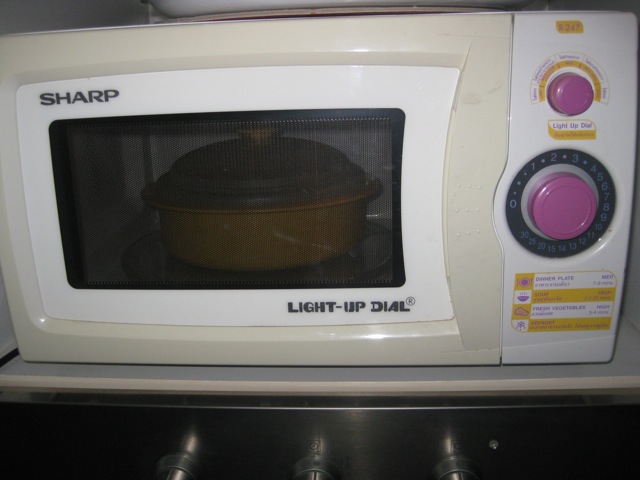
Sharp Light-up Dial Microwave
Photo by Twentyfour Students on Wikimedia Commons

Take the turntable out of the microwave (or prop the chocolate flat on an inverted bowl), lay the bar on a plate, and run the oven for 20 to 30 seconds. Soft spots appear in rows. Measure three separate spacings between neighboring spots and average them: I got 6.0, 6.2, and 5.9 cm, so 6.03 cm. The spots are standing waves: microwaves bounce off the metal walls, and where the reflected waves add up, the chocolate melts first, half a wavelength apart.

Microwaves are light, and the hot spots sit half a wavelength apart, so the wavelength is λ = 2 × 6.03 cm = 12.1 cm = 0.121 m. The frequency is printed on the back of the oven: 2.45 GHz = 2.45 × 10⁹ Hz. Multiply: c = fλ = 2.45 × 10⁹ × 0.121 = 2.96 × 10⁸ m/s. The accepted speed of light is 2.998 × 10⁸ m/s, so a chocolate bar and a ruler get you within 2%. Don’t run the oven empty, and don’t touch the chocolate for a minute afterward.

The chocolate covers light. Sound takes two phones and a stairwell. Put one phone 10 m away, record on both, clap once, and compare the waveforms: my clap arrived 29 ms late. Speed is distance over time: 10 m / 0.029 s = 344 m/s. Sound in air runs about 331 + 0.6T m/s, where T is in Celsius, so 344 m/s matches a room at roughly 21 °C. That’s my room, checked with the same thermometer I use for the kettle.

Your precision comes from the waveform display. A clap judged by ear carries an uncertainty of 0.1 s at best, which would ruin the measurement; a recorded waveform lets you read the delay to about 1 ms. That’s a factor of a hundred, gained by changing the tool instead of trying harder.

Write each measurement down as you take it, with its unit, and keep the raw values: the 40.2 s, the 212 g, the 670 mL. Computed answers are cheap; the raw measurements are what another person needs to judge your work. Repeat each measurement at least twice and average. Report the spread, even if it’s just “two runs within 0.5%”.

State your expected accuracy before you measure. For g from a shoe, 9.8 ± 0.2 m/s² is a realistic claim. For the speed of light from chocolate, 3.0 × 10⁸ ± 0.2 × 10⁸ m/s. Setting the range first removes the human temptation to round toward the textbook. Then hand the raw data to someone else and let them compute the answer. If they get 9.8 m/s² from your 40.2 s, your record-keeping worked.

For the general map of what all these measurements belong to, the reference I keep sending students to is the overview of physics on Wikipedia. Read it for ten minutes, then put the phone on stopwatch duty and start swinging the shoe. The point of these experiments is that they force you to confront your own measurements rather than the answer key. The potato doesn’t grade on a curve.

Categories
General

Why Physics Still Starts With Units

Every September I write a wrong equation on the board and wait. This year it was v = a·t². It takes about forty seconds before somebody frowns. Velocity comes in meters per second, acceleration in meters per second squared, and multiplying that by a time squared gives plain meters. Meters on one side, meters per second on the other. The equation can’t be true, and we haven’t done any physics yet. We’ve only looked at the units.

That check has a proper name: dimensional analysis. Every quantity drags its unit along, and the units on both sides of an equals sign have to agree, the same way the number of terms does. It costs about ten seconds per equation and catches a remarkable share of mistakes before anyone reaches for a calculator.

The ten-second check

Cheque for the second sale of Wellcome Trust shares. Wellcome L0030633
Photo by Unknown on Wikimedia Commons

Take a plain problem. A car accelerates at 2 m/s² for 5 s. Its speed is v = a·t = 2 m/s² × 5 s = 10 m/s. Watch the seconds: the acceleration carries s² downstairs, the time brings one s upstairs, so a single s survives downstairs. 10 m/s is 36 km/h, which is plausible for a tired hatchback. If your arithmetic had said 10 m/s², the units would have complained before the answer sheet did.

The same habit handles conversions. One kilometer per hour is 1000 m divided by 3600 s, so 1 km/h = 0.278 m/s. When you multiply a speed by that ratio, the old unit cancels, because the ratio equals 1 and multiplying by 1 changes nothing. It’s ordinary arithmetic dressed in units.

History supplies a fine warning. In 1999 the Mars Climate Orbiter was lost because one engineering team computed thruster impulses in pound-force seconds and the navigation team read them as newton seconds. The conversion factor is 4.45, and the spacecraft missed Mars. The units failed that day, along with a probe worth about $125 million. When I tell this story, the room gets very quiet, and the next homework comes back with units on every line.

Guessing formulas from units

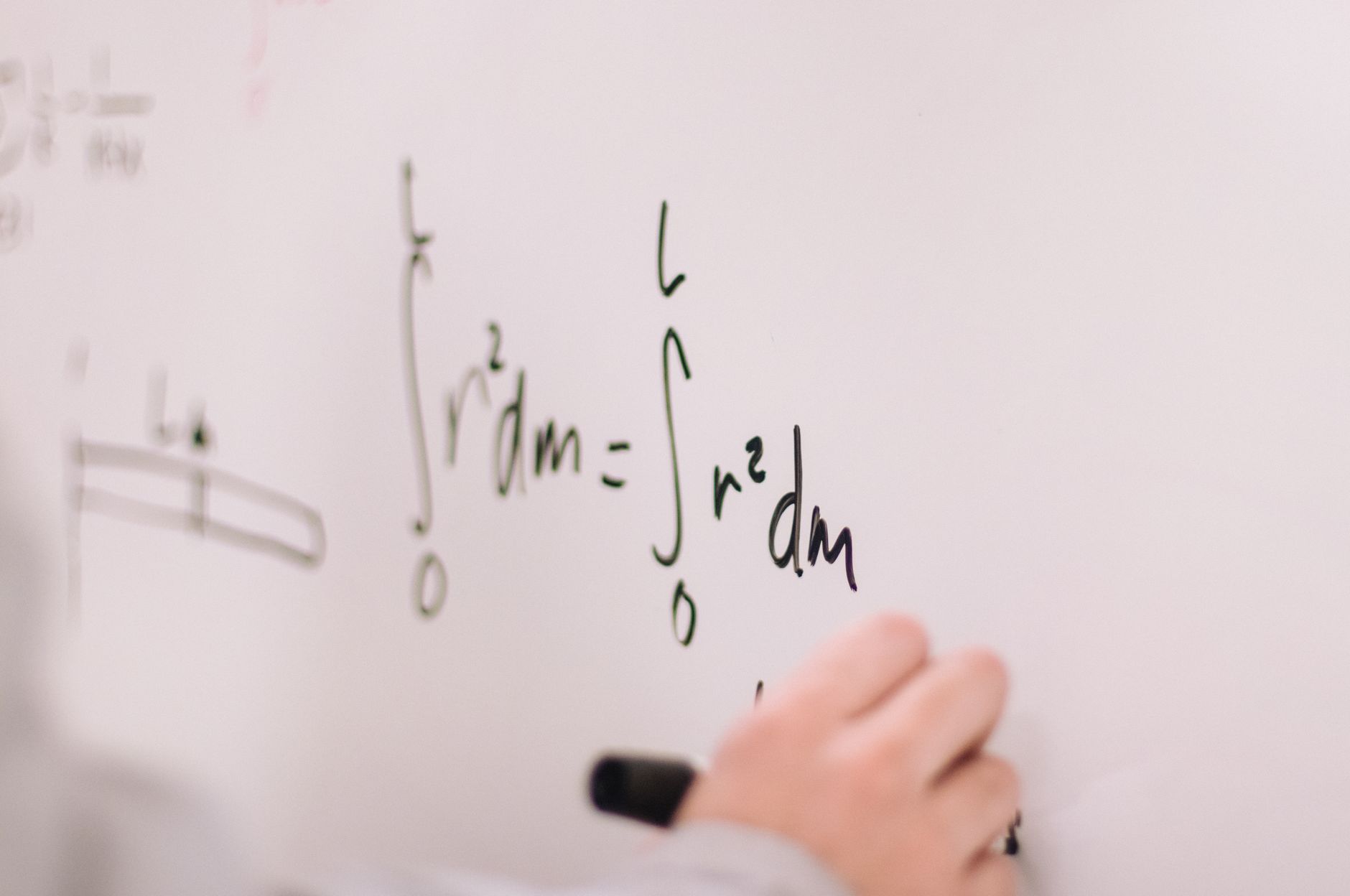
Person writing math equations on a whiteboard, focusing on integrals and formulas.
Photo by Jeswin Thomas on Pexels

Units can also build formulas, which students find slightly suspicious the first time. The period T of a pendulum depends on its length L, the bob’s mass m, and g = 9.8 m/s². Does the mass matter? Mass lives in kilograms, and no combination of kilograms alone produces seconds. Drop it. Look at L/g instead: its units are (m)/(m/s²) = s², and a square root gives seconds. So T = C·√(L/g) for some number C. Time a 1 m pendulum once and you get about 2 s per swing, so C is close to 2π. There’s the formula, and nobody solved a differential equation.

A 1 m pendulum really does swing with a period near 2.0 s. Try it with a shoe on a shoelace and a phone timer. If you measure 1.5 s, you either started counting at the wrong place or own a very short shoelace.

Where it saves you later

smiley, later, dice, fun, faces, emoticon, mood, smilies, feelings, emotions, emotion, smile, various, later, later, later, later, later
Photo by Alexas_Fotos on Pixabay

Units also connect topics that look unrelated. Pressure is force over area, so 1 Pa = 1 N/m², and a car tire at 220 kPa holds 220,000 N on every square meter, about 2.2 atmospheres. The newton itself breaks down into base units: 1 N = 1 kg·m/s². Nobody needs to memorize that. You rebuild it in ten seconds when you need it.

Once the numbers get large, units are the cheapest sanity check available. A car battery stores roughly 5 × 10⁶ J. A cup of hot tea carries about 2 × 10⁵ J. If a calculation tells you the kettle boiled with 3 J, you dropped a factor somewhere. If it tells you the tea holds 2 × 10¹⁰ J, you’ve invented a small bomb, and I’d like to see the kitchen.

So I keep the habit on the board all year. Write the unit next to every number, cancel units like fractions, and read the answer’s unit before you read its digits. The digits tell you the size. The unit tells you what you actually found, which is usually the harder question.